Fork In Review

Jan Hume

Film Review: “Foodies; The Culinary Jetset”

This documentary was part of the Sydney Film Festival 2015. It follows some food bloggers who fly around the world with the express purpose of dining at the most expensive restaurants, eg. Noma. They get selfies with celebrity chefinators, and take photos of the (usually small) objets d’art which are about to be wolfed down in seconds.

The objet d’art has a very short life between kitchen and stomach, therefore making it seem a bit pointless. It’s possible that the bloggers probably feel they are performing a very important social service. But they’re not really, because these celebrity chefinators are very unlikely to dish up something that is not palatable or immaculate, with no cause for complaint.

However, one of the bloggers, Andy Hayler, managed to find something to complain about – a lobster dish, and the French champagne he’d consumed. This caused the cinema audience to laugh, perhaps thinking something like “self-indulgent prat”, “poor wee petal”, or “first world problem”.

The Chinese blogger, Katie Keiko, was shown around a kitchen after her meal, and she looked lost. The inference from this could be that she had little idea about the production end of the food – only about the conspicuous consumption. How about a selfie with a celebrity farmer instead?

Would it be plausible to suppose that a food blogger might arm themselves with a smidgen of knowledge about food and cooking?

Then there was the Lithuanian ex-model turned celebrity blogger, Aiste Miseviciute. She flew to Japan, where there was a shot of her at a fine dining restaurant to eat two pieces of sashimi fish and leave. There were no signs of wasabi, pickled ginger, sake or tea. From what the viewer saw, it appeared to be an abstemious and joyless experience. Where is the satisfaction in eating two bits of plain raw fish? With no condiments or accompaniments?

The opinionated New York blogger, Steve Plotnicki, just wanted an argument! So he had one with chef Wylie Dufresne at his restaurant, WD-50.

Before we make accusations about conspicuous consumption which these bloggers open themselves up for, one of them correctly pointed out that other expensive hobbies are more easily accepted.

The big question is why are these bloggers so influential?
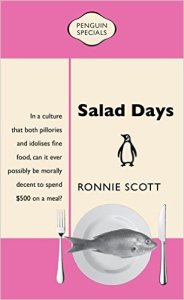
Book Review: “Salad Days” by Ronnie Scott

41ehOXo6UAL._SX305_BO1,204,203,200_It appears that Scott has dined with a restaurant reviewer, and he seems to be exploring some thoughts  about cuisine, restaurants, and trying to justify his keen interest in fine dining.

He says that a restaurant’s job is to dress up ingredients for sale. It’s done in an attractive setting at sometimes unattractive prices. Unlike a painting or a sculpture it’s gone in 5 minutes. The smarter the restaurant, the more it costs.

If one has dined at say, Noma, el Bulli or Fat Duck, it’s saying “I’ve been there”.  Numerous people could be justified in thinking this is morally indefensible, when a large percentage of the bill could have been donated to a charity instead. The more conspicuous the consumption of it appears to be, the more the ethics are questioned, compared with say slurping a bowl of noodles in a food court.

People construct their identity and culture through consumption choices and rituals including those associated with food. Leisure consumption is where differentiation, assimilation and style of commodities are most visible, ie. an opportunity to express one’s identity in the public sphere.

You can see this when people post a photo of their latest meal on their blog or Facebook, and the review is limited to: OMG it’s awesome!!!!!!!!!

If some Gen Y consumers don’t cook a lot they presumably obtain cooked food via retail. And possibly eat it in front of a cooking show on TV. This means that their relationship with food and identity are somewhat distorted.

“Salad Days” is the right name for this essay. Scott has yet to explore more deeply some food issues beyond fine dining restaurants. For example, the influence of immigrants in Australia, or whether Australia has a cuisine. Or the assertion that food in Australia is largely seen as fuel. Or the price pressures Australian farmers have to withstand from the large supermarkets, which could result in the lack of viability of sustainably produced food. Or the effect of farmers going out of business because their land is being fracked. These issues are worth exploring much more than if someone blows $500 on a feed.

But as Thea Brooke says in her blog: the essay is an amuse-bouche for a plane ride.


Evening Classes in Food

This is a tongue-in-cheek piece on food education.

Food and General Knowledge:

A gastronomer will answer your questions to issues which may confuse you – here are some examples:

  • A diner was offered “chips with that” when served dinner no matter what the meal consisted of.
  • Is cooking really necessary?
  • Deep-fried Mars bars – are they a joke, or a genuine addition to Scottish cuisine?
  • Why are kebabs are better at 3am?
  • Ironic food eg. prawn cocktail enables cool people and hipsters to eat retro.
  • Why do expensive restaurants serve peasant food?
  • A complaint that the diet industry slims down the wallet only.
  • Superfoods – aren’t they just health foods?
  • Why we should queue for pink cupcakes and multi-coloured macarons?
  • Do restaurant reviewers live in a bubble? And are they necessary?
  • Supermarkets ravage towns with too much choice.
  • Packaging, air miles, carbon foot print – they don’t want to be the entire world’s conscience.
  • Microwaved convenience food – what’s wrong with it?
  • Does Australia have a cuisine? What does it consist of?

Food and culinary terminology:
Are you uncomfortable with “poncy” food terms? Is polenta a by-product of an Italian building material? A round-table discussion led by a TAFE cookery teacher to help people feel comfortable reading menus, and translate tricky words and products, eg. assiette, du jour, melange, timbale, jus, ceviche, drizzle, sommelier, truffle oil.

Food of the 50s & 60s:
The CWA will give a refresher talk and some recipes eg. savs and pavs, party pies, French onion dip, cocktail onions, meat and 3 veg. This is a winner for baby boomers.

Vegetable Matters:
This is a 2-part demonstration: one from a Chinese chef, and one from an Italian chef. eg. kale, eggplants, zucchini, bok choy. What are superfoods? What are wild foods? What is forgaging? What is the difference between sundried and sun-blushed tomatoes? Farmers’ Markets – are they only for the rich? This class will increase the confidence of those Australians who have not eaten out much. This is a good class to do following food of the 50s & 60s.

Budgeting: home cooking versus take away food versus restaurant food:
A very simple tutorial will be given by an accountant, using a calculator. Bring your mobile phone.

How to read food packaging:
Pictures and instructions on food packaging are confusing. A lesson and translation will be given by an expert from a well-reputed consumer organisation.

Restaurant Reservations:
Why they are necessary?  Do they limit your freedom?
How to make reservations, plus follow-up.

Eating in a Restaurant:
A maitre d’ from a top restaurant will co-ordinate tutorials. A 2-part course which deals with important topics, such as:

  • Reading the menu and explaining food terminology (please see course above).
  • Knowing what you are eating – demonstrations from a chef, a home gardener, a fishmonger, and a butcher.
  • Menu pricing,  ie. does the figure 25 without the $ sign mean dollars or cents?
  • Wines, glasses and wine matching – a demonstration from a sommelier.
  • Napkins – are they different from serviettes, tissues and handkerchiefs?
  • Learning about items on the table eg. boards, glasses, condiments – demonstration about usage from a head waiter.
  • Cutlery –what are fish knives? Parfait spoons? Butter knives? Jam spoons?
  • Are table manners harmful to your wellbeing? eg. where to put your elbows, mobile phone usage, conversation – role play and simulation with some experts in manners.
  • Occasional queries eg. seating density, noise levels, loud music.
  • Complaints – are they different from mood swings? Do all waiters have personality disorders? How to assert yourself when the waiter refuses to understand your point of view. How to get over simple explanations.  Relaxation exercises. A panel will answer questions, and a counsellor will be available.
  • Living with tipping – Why? What is appropriate? Getting over it. A tutor and a counsellor will answer queries.

Food on Television:

  • The differences between home cooking and TV cooking. A talk will be given by a qualified chef.
  • Is Masterchef far too serious? Criteria useful to critiquing your parent’s cooking. A panel discussion with a TV reviewer, some non-celebrity chefs, parents who can cook, and a food reviewer.
  • Is My Kitchen Rules the model for a contemporary dinner party? A panel discussion, as above.
  • Celebrity chefs – is bullying more fun when Gordon Ramsay does it? A panel discussion with a TV reviewer, psychotherapist, ethicist, and a celebrity chef.
  • Nigella has ‘no time’- so how does she manage her TV shows?
  • How to do a cooking dem on a canoe during a storm.