Fork In Review

Jan Hume

Restaurant Reviewing

Remember the saying “I don’t know much about art, but I know what I like”? It seems that the same holds for restaurant reviewing, but with a twist: “I don’t know much about food, so I will show you a photo. Oh, and troll around in other websites !”

There has been some media commentary about bloggers in particular, offering all sorts of opinions about restaurants where they have eaten.

Restaurant reviewing is like a consumer service similar to Choice magazine. However Choice tests products rigorously, whereas restaurant reviewers rely on their personal preferences and tastes, which are highly subjective. And the level of food knowledge varies greatly, eg. I remember brunching with someone who complained that the toast was too hard. Well, it was sourdough and it was toasted. Hello?

Unfortunately, this sort of ignorance is now published, so that these people can display their level of knowledge for the whole world to see. These public comments are hurting perfectly good restaurants, because other uninformed people read these comments and believe them. Bad for business and often unjustified.

A news story was published about this issue (SMH 24/6/12 Table Service: Social media setting the course of our restaurant choices). There are some blogs and websites where diners can click and rate their performances no matter what their mood, personality disorder, or knowledge of food and cookery. And this data is in the public domain influencing all other self-styled and not so well-informed “reviewers”. They often confuse “I don’t like it” with “It’s no good”.

Whilst censorship or denial of free expression are not desirable, these websites are putting restaurants at a huge disadvantage. This is clearly unfair, and can influence potential diners to the extent that a perfectly acceptable restaurant is forced to close. Such is the power of some of the ignorant trolls, and those readers who believe them.

Let’s hope serious reviewing publications will maintain enough integrity, so that reasonable and better informed reviewers and diners’ reviews will prevail.

A friend and I recently went to a restaurant which serves excellent food, but was clearly understaffed, because the floor staff  were running around like headless clichés. Either the owner was too mean to pay another wage, or a waiter did not show up for work due to illness.

By 7pm the restaurant was full and our waiter was efficient in my opinion, but in my friend’s opinion she was rude.  I used to work in the hospitality industry so I have a different perspective. It’s all about perceptions. It was obvious that the restaurateur should have hired an extra waiter. They would have been aware that it was going to be another busy Saturday night. And it keeps the trolls off the websites.

Just because a diner who can’t cook, but can use social media and a camera, do they deserve to be taken seriously?

I think not. I would rather take notice of an experienced chef, who has had years of experience. Would you take seriously the word of a journalist who wrote about economics, but did not have a degree, or working experience in the discipline? Or a plumber, or car mechanic?

Knowledge about writing advertising copy, photography and IT skills should not be confused with knowledge of cookery and restaurant service. And chefs need to exercise their right of reply.


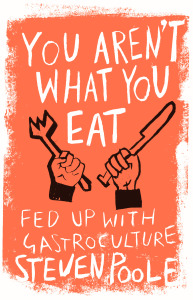
Book Review: “You Aren’t What You Eat” Stephen Poole

YOUARENTWHATYOUEAT_300dpiRemember when you just cooked a meal and ate it? If there was a special occasion you referred to a cookbook. For something really special you could get some ideas from one of a huge number of TV cook shows, or one of Jamie Oliver’s cookbooks for example.

Currently, some TV cooks take beautiful ingredients and turn them into snobbery, fads and platforms for these cooks’ own self-aggrandisement and peddling of a plethora of products.

This, in turn, has kept people ignorant of actual cooking, created a problem of perspective and this has become almost a pathology. This is the premise of Stephen Poole’s book. To quote AA Gill:  “It’s now all lifestyle, soft porn and pouty personality”.

From his book it is very easy to extrapolate a few types:

The cooking gadgeteer – must have every mechanical device seen in the glossy mags, TV shows and websites. The gadget is hardly ever used, but promoted from the back of the cupboard to the bench top at Xmas time.

The food intolerant person [this includes eating disorders] –goes through every menu item with the waiter to find out exactly what’s in everything. They could have phoned the restaurant beforehand [but not in the middle of service] to find out if there are residual crumbs of nuts in the béchamel sauce, and think about how busy the kitchen staff might be. The rest of the table are embarrassed and trying to ignore it all.

The photographer [or artist] – a knife and fork are not quite enough; one must use a camera and get in the waiter’s way while snapping a work of art. The fact that they’re a damn nuisance just doesn’t occur to them. Plates now are just too mundane to serve food on. Boards and slates are de rigueur, and must be foamed, squirted at or dribbled on. Then upload the photo to the blog.  Oh, and it’s good if the dishes have sound effects from nature played while they’re being eaten.

The chef as gardener – this also includes foraging and locavorism which is similar to 19th century gleaning. It’s basically picking weeds and edible plants from the wild, preferably close to home, and putting two leaves on a large slate.

The chef as food historian – this person mostly cooks for pubs and turns old fashioned working class food into posh food for three times the price.

The food prognosticator – this brilliant person knows how to scrutinise a crystal ball and divine what items will be “on trend” next. For 2013, they are Mexican, Chinese, Korean, Peruvian, artisanal goods, food trucks, children’s food for adults, casualization of menus and more share plates. The implication seems to be that if you’re not consuming these foods, you’re a dag.

The foodie adventurer [similar to the party animal] – these are people who default to hamburgers, steak, fish or schnitty and chips. They want to try something new because they love Bali, and everything is so different there. It’s like being in a foreign country without the plane ride. Can be uncomfortable, though, especially when there’s no air-con. And it can be a bit confusing about what sort of meat is in the curry.

What about the chefs and food writers? It’s their job to keep one step ahead of the class, just like school teachers, offering a new TV series, live shows, books, apps and other trends and gizmos. Luckily, this can be quite fun. For example, in the television series The Trip, fashion and menu euphemisms were sent up deservedly- froth, foams and drizzles are part of the culinary zeitgeist. Also, Cleaver Greene started an episode of Rake sending up something pretentious on a menu.

It seems that Stephen Poole, the writer, might have overreached himself. He sometimes dismisses, over simplifies and sneers at all these chefs, consumers and their activities and beliefs. It could be inferred that he feels a bit threatened by someone who can differentiate between a chermoula and a harissa. Or knows in what season peaches ripen.

He implies that Nigella Lawson is almost a gastro porn star, with sexual body language and double entendre. Her vampish performance may be irritating or enticing, but she does understand that the point of food is eating. And not so much art, photography, eating disorders, neuroses, or eco-war.

Poole tries hard to slap off Jamie Oliver, saying that it must be hard for him to keep going on the treadmill of novelty. If the two favourite dishes in Britain are roast chicken and curry, then Oliver combined the two and made Empire roast chicken. Poole wrote this off as gimmickry, whereas it could be viewed as a creative idea, and easy to cook.

Oliver’s school food program is inspiring and would be seen as eminently sensible to most reasonable people.  It’s relevant, popular, important, and implies that parents need to take some responsibility for their kids’ health.

Further on this theme, Michael Pollen’s famous quote is “Eat food. Not too much. Mostly plants”.  Later in his book, Poole has a sneer at Pollen’s suggestion that people should know where their food comes from and respect it. He seems to imply that being familiar with soil, gardening and the cultivation of vegetables is “foodist rhetoric”, and a tree-hugging hippy fixation.

He does not denigrate vegetarians, for example, but he does denigrate those who make ethical choices which are based on spurious marketing claims rather than substantial ones.  For example, Nigella’s “Meadow on a plate” is pushing credibility a bit.

Poole dismisses antipathy to GM foods, overlooking the undesirable and excessively litigious behaviour of some of its corporate producers.

He oversimplifies locavorism which is related to foraging. It makes sense to eat food produced near home, due to cheaper transport costs, and less fuel pollution. But one needs to consider the side effect that buying vegetables from an African village may just give those villagers the boost they need in self-sufficiency.

Does it really matter if 60 years ago the Soil Association had members who were Fascists? Does it mean they espouse fascist views today? Probably not.

I suspect most people are going to believe the opinions of an experienced soil biologist about how to assess the health of soil, than a chef or a misanthropic food writer.

Hugh Fearnley-Whittingstall and Fergus Henderson seem to do the right thing by the environment and show respect for its products. But Poole still manages to discount their aims with some sort of sneering qualification.

The reader could be forgiven for thinking that Poole is sore about something. Some chefs can do their best for the product, the diner, the environment, and the cookery profession, but it’s still not quite good enough for Poole. I suggest he does a bit of homework; some deeper understanding generally cuts down the urge to sneer.

However, I agree with his desire to puncture pretence, snobbery and narcissistic consumerism. This is a job long overdue; he twists the knife dextrously, and to great satisfaction.
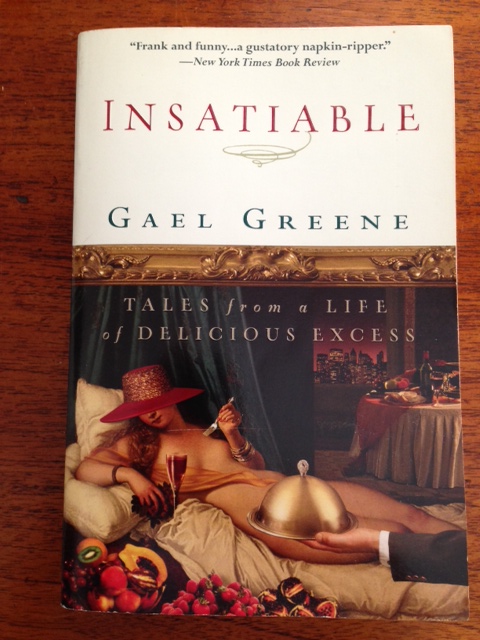


Book Review: “Insatiable” Gael Greene

Insatiable - Greene, Gael

At the end of this book, subtitled Tales from a Life of Delicious Excess, there is a list of discussion questions. Presumably, this is aimed a book groups. I will attempt to wrestle with some of these:

1.  Ultimately, Insatiable is about more than food, restaurant reviews, and sexual encounters. It is about a woman who reinvents herself. What are Gael Greene’s strengths and weaknesses, and how does she use both in creating her persona?

Greene’s weakness is that she gives too much information; her strength is that her writing style is very readable. The result of this is that Insatiable is a reinvention of herself: a woman with a voracious appetite for food and sex, and then telling everyone about it. Unfortunately the persona does not seem to have a lot of personal awareness about how she embarrasses herself.

7.  What qualities does Gael Greene value when she reviews a restaurant? Can you construct “guidelines” a la Gael Greene? If you choose one of your own favourite restaurants (or a popular franchise) and reviewed it from a “Gael Greene” point of view, would it be a pick or a pan?

From reading Insatiable it seems that Green’s guidelines would likely be:

  • Namedrop as much as possible, reveal who’s who and if they are seated “in Siberia”
  • Be on intimate terms with the chef, and don’t worry about the neutrality of the review, or conflict of interest.
  • Eat and drink only the most luxurious items on the menus
  • Don’t worry too much about culinary technique, or the provenance and production of the primary products.

If I reviewed a top Sydney restaurant from a Greene pint of view it would be a pan. The main reason for this is in 2013 there are not too many restaurants which serve foie gras and truffles. And not too many customers want this, or to have it washed down with expensive champagne. That all seems a bit dated now.

Also, in a city like Sydney reviewing from the Greene point of view would result in derision and loss of reputation. One wouldn’t get away with that type of behaviour emanating from an oversized ego.

8.  Gael Greene talks about being a “foodie” and about “foodism”. What does she mean? What evidence can you point to that we have become a nation of “foodies”?

It seems that in the 80s “restaurant madness had New York in a frenzy”. Restaurants became used more sophisticated and unusual ingredients and drew inspiration from more cuisines. Foodies, according to Paul Levy’s Official Foodie Handbook, are “all palate, with a vestigial person attached”.

Eating out increased. People learnt what brand names to remember, what new foods to consume, what chefs worked where and how many stars they had.

But not many of these consumers learnt how to cook it themselves. So the foodism wasn’t based on solid knowledge or experience.

9.   When you next dine out, will you view the experience any differently after reading Insatiable? If so, what specifically will you be paying more attention to?

Probably not very much more. But if I did I would look at all aspects of eating out, and not be too concerned about what had happened to it before it arrived on the plate. That is, the décor, the chef’s background and reputation, and the crowd.

11.  For Gael Greene, food and sex are inextricably linked. What do both hungers have in common – for Gael or for anyone?             

Food and sex are linked in that some have appetites for plenty of one, or the other, or both. I think these hungers may have something to do with unmet needs. Obviously the body needs fuel to stay alive, but maybe an insatiable hunger for sex is related to the need for emotionally intimacy. That’s obviously idle speculation.

This issue was best summed up in John Newton’s review of Insatiable in the Sydney Morning Herald on 28/4/07.

16.  Do Insatiable and Gael Greene deserve a place among the gastronomic classics? From the writing to the content, what puts this book a cut above the rest?

This book does not really deserve a place among the gastronomic classics.